
People with severe and profound intellectual disabilities
A VR case set in the daily support of people with severe and profound intellectual disabilities.
Apply
For professionals who support people with challenging behaviour.
About the training
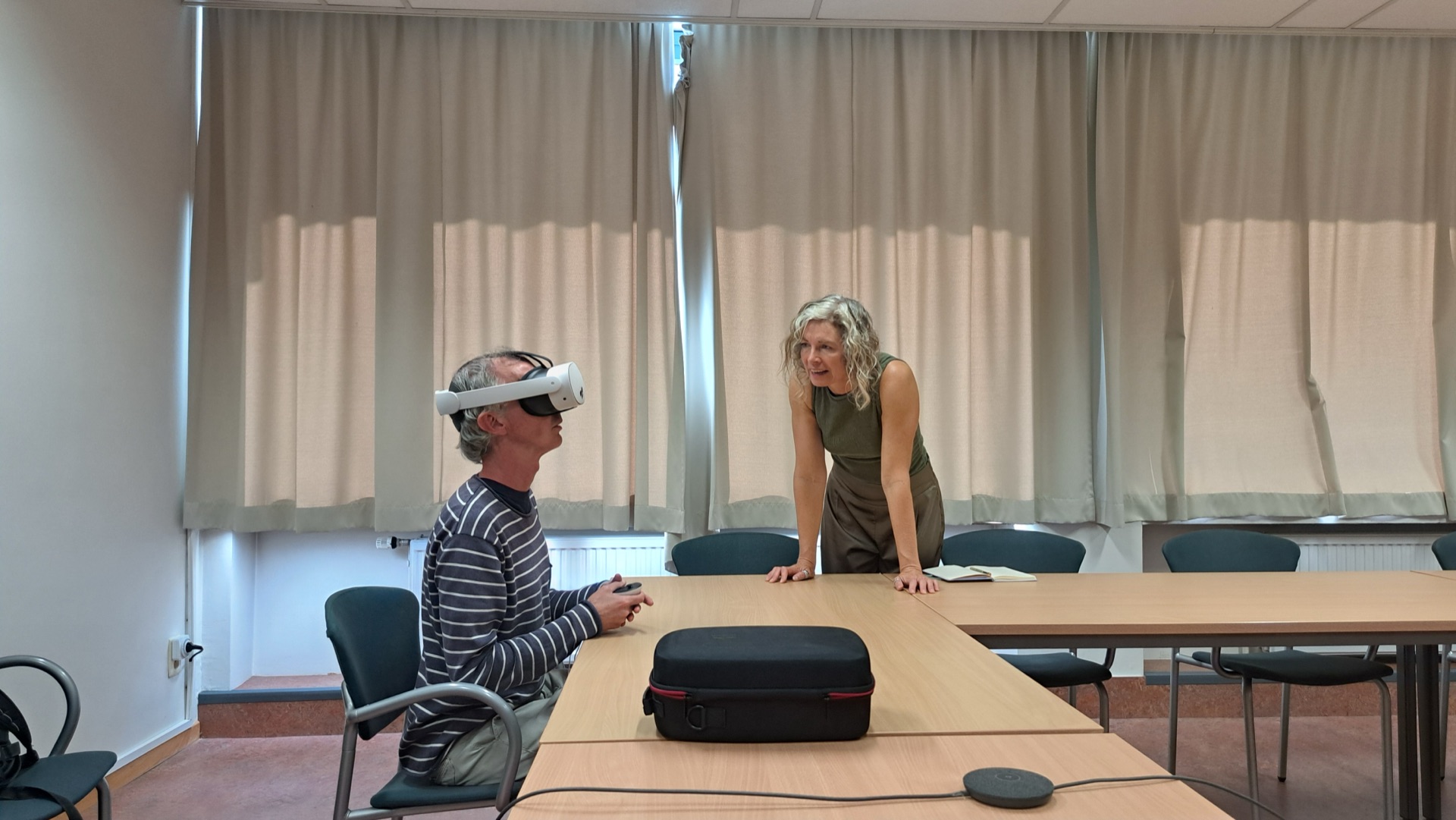
The VR training is a realistic and safe learning environment in which support workers can experience challenging behaviour from an immersive perspective, make different choices and experience the consequences of those choices. The reflective conversation afterwards offers the opportunity to open up the dialogue. In this way we want to contribute to a better understanding of challenging behaviour, and of how complex it is to support people in such situations.
The VR training offers a safe way to experience and to talk. You go through the training together with your colleagues, at the same time. Afterwards you talk in confidence about the things that are sometimes hard to discuss, and about the strengths and talents within the team.
Exploring, recognising and sharing experiences, feelings, thought patterns, vision, approach, your own unique style of support and professional responses when working with people with challenging behaviour, based on a VR case.
There is no clear right or wrong and there is no assessment. It is a chance to practise and to try things out in a safe environment, followed by a debriefing.
Scenarios
A VR case set in the daily support of people with severe and profound intellectual disabilities.
A second VR case, set in the support of people with mild intellectual disabilities, is in development.
Formats
A team training for a maximum of 8 participants, led by our team.
Apply for the trainingLearn how to apply the fundamentals of the TRM (Team Resource Management) principles and the PEARLS debriefing tools within your organisation. After completing this training you can become a specialist for the VR training program and bring your expertise to other institutions as well.
Apply for the trainingWhat happens next
We schedule an intake talk with the applicant or team lead to understand your specific needs and focus points.
We plan a training session in the format that suits your needs and wishes best.
You receive background information and study material to prepare your team for the training.
You are ready to take part in the VR training or the train-the-trainer program.
Costs
This training has been developed with a grant from the European Union. Our aim is to make the VR training and the debriefing method available to as many teams as possible that need it.
€800
per session
Application form
Tell us about your team. We will contact you to schedule an intake talk.
Do you want to become a trainer and join our team as one of the experts travelling the Netherlands and Belgium? Or do you want to become a trainer to implement the VR training within your own organisation on a structural basis? That is great.
We are currently working on the train-the-trainer program, so it is coming soon. If you want to be one of the first to join us, please fill in the application form.
Partners





This project is co-funded by the Erasmus+ programme of the European Union. Views and opinions expressed are however those of the author(s) only and do not necessarily reflect those of the European Union or the granting authority. Neither the European Union nor the granting authority can be held responsible for them.